The English Premier League schedule and fixtures for the 2026/2027 season feature 20 clubs across 38 matchweeks and 380 matches. The campaign began on August 21, 2026, and ends on May 30, 2027. Key dates throughout the campaign appear across the EPL schedule, including weekend rounds, midweek rounds, international breaks, and domestic cup periods. Arsenal opened the season against Coventry City at Emirates Stadium. Matchweek 4 features Sunderland versus Arsenal and Manchester United versus Manchester City from September 12 to September 14. Kickoff times vary according to broadcast selections and scheduling requirements. Match dates, venues, opponents, and kickoff times give fans a clear structure for following league action throughout the season.
The English Premier League schedule and fixtures provide club-by-club information across the complete league campaign. Home and away matches form the core of the EPL fixtures, giving fans a clear record of each club's commitments. International breaks occur during September, November, and March. European competitions, FA Cup rounds, EFL Cup commitments, stadium availability, policing requirements, and broadcast selections influence fixture changes. The final match round takes place on May 30, 2027, when matches begin simultaneously at 16:00 BST. Fans use the English Premier League Schedule to track upcoming matches, follow club progress, plan viewing, and identify key fixtures across the season.
EPL Schedule and Fixtures 2026/2027 Season
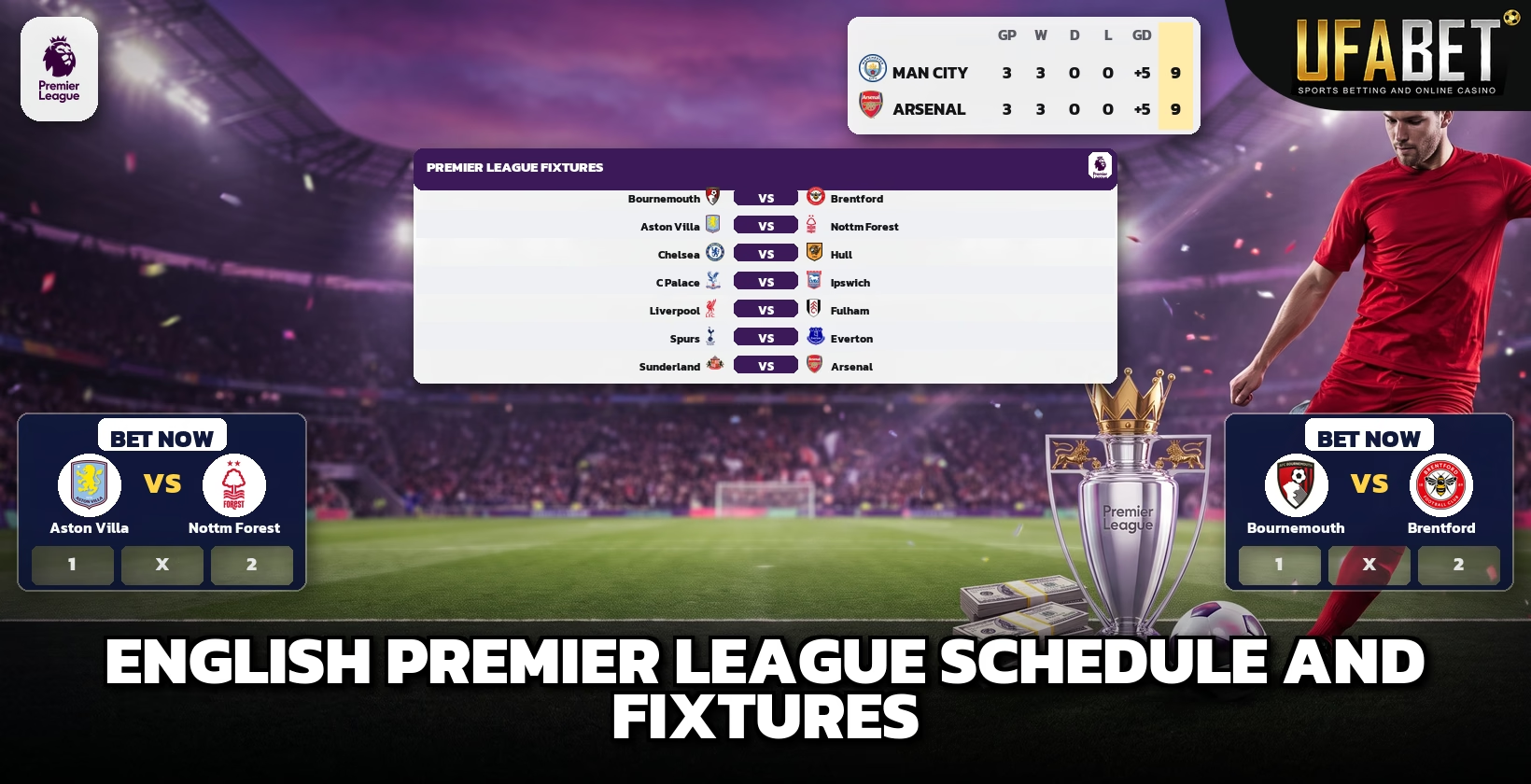
The latest EPL schedule covers upcoming fixtures from Matchweek 4, scheduled from September 12 to September 14, 2026. Match listings include the matchweek, date, kickoff time, participating teams, venue, and fixture status. Scheduled matches feature clubs including Arsenal, Liverpool, Chelsea, Manchester United, and Manchester City. Upcoming fixtures provide a current view of the English Premier League calendar.
The EPL schedule and fixtures 2026/2027 season are shown in the table below.
By Month
NOVEMBER 2026
Saturday, 21st Nov
22:00
Aston Villa
Sunderland
Not Started
22:00
Bournemouth
Nottingham
Not Started
03:00
Brentford
Everton
Not Started
22:00
Chelsea
Leeds
Not Started
22:00
Coventry
Crystal Palace
Not Started
21:00
Hull
Brighton
Not Started
23:30
Liverpool
Man Utd
Not Started
19:30
Manchester City
Fulham
Not Started
00:30
Newcastle
Arsenal
Not Started
22:00
Tottenham Hotspur
Ipswich
Not Started
Coming soon
How to Bet on Premier League Games on UFABET?
Premier League betting follows a simple process across available match markets. Account access, match selection, market selection, stake entry, and bet confirmation form the main steps. Available options vary according to scheduled fixtures and market availability.
To bet on Premier League games on UFABET, follow the five steps listed below.
Access UFABET
Open the UFABET platform and enter the betting section. Select Premier League fixtures from the available football competitions. Match listings display scheduled games alongside available betting markets.
Select a Match
Choose a Premier League fixture from the listed matches. Review both teams, kickoff time, and available markets. Match details help identify the preferred betting option.
Choose a Market
Select a market based on the preferred match outcome. Available markets include Match Winner, Asian Handicap, Total Goals, and Correct Score. Each market displays corresponding odds before bet placement.
Enter the Stake
Enter the preferred stake amount beside the selected betting option. Review the displayed odds and potential return before confirmation. The bet slip shows the selected market and entered stake.
Confirm the Bet
Review the complete bet slip before submitting the selection. Confirm the chosen fixture, market, odds, and stake. Completed selections appear within the account betting records under Football Betting.
What Premier League Matches can you Bet on UFABET?
Premier League betting covers several markets across scheduled league fixtures. Match Winner and Asian Handicap markets focus on expected match outcomes. Goal-based markets provide options linked to scoring patterns and final results.
The Premier League matches that you can bet on UFABET are listed below.
Match Winner: Match Winner betting focuses on the team expected to win. The available selections cover the home team, draw, or away team. Odds change according to market expectations.
Asian Handicap: Asian Handicap betting gives one team a virtual goal advantage or disadvantage. The market creates adjusted outcomes around the final score. Handicap lines vary according to match expectations.
Total Goals: Total Goals betting focuses on the combined goals scored by both teams. Selections commonly cover over or under a listed goal line. Final settlement depends on the match score.
Both Teams to Score: Both Teams to Score betting predicts whether each team scores during the match. Selections cover yes or no outcomes. Match goals determine the final result.
Correct Score: Correct Score betting predicts the exact final score. Available selections cover different home and away score combinations. The final score determines the winning selection.
First Goalscorer: First Goalscorer betting focuses on the player scoring first. Selections depend on the players listed for the fixture. The first goal determines the winning selection.
Half Time Markets: Half Time Markets focus on match outcomes during the opening 45 minutes. Options cover results, goals, and selected scorelines. The halftime score determines the relevant outcome.
How do Premier League Betting Odds Work on UFABET?
Premier League betting odds work on UFABET by assigning numerical values to predicted match outcomes. Odds reflect the implied probability attached to markets, with shorter odds indicating a stronger market expectation. For example, a 1.50 price implies about 67% probability before bookmaker margin, while 3.00 implies about 33%. Match winner markets cover home win, draw, and away win selections. Handicap markets adjust the starting goal position, while total goals markets focus on lines like 2.5 goals. Betting returns depend on the selected odds and stake size, with a $10 stake at 2.00 producing a $20 total return before applicable deductions. Live odds change as match events occur, with goals, red cards, injuries, and time remaining affecting market prices. Premier League fixtures therefore receive different odds across match and live betting markets.
What are the Most Anticipated Premier League Games This Season?
Premier League fixtures feature several high-profile matches involving title contenders, historic rivalries, and ambitious clubs. Arsenal versus Chelsea provides a major London matchup during the 2026/2027 season. Manchester City versus Coventry City presents an established club against a promoted side. Nottingham Forest versus Tottenham Hotspur adds another competitive fixture, giving readers useful context alongside the EPL Standings.
The most anticipated Premier League games this season are shown in the table below.
Match
Date
Venue
Main Storyline
Importance
Why It Is Anticipated
Arsenal vs Chelsea
September 6, 2026
Emirates Stadium
London rivalry
Title and European race
Major London matchup involving two prominent Premier League clubs
Everton vs Manchester United
September 6, 2026
Hill Dickinson Stadium
Historic rivalry
League-position implications
High-profile fixture involving two major English clubs
Manchester City vs Coventry City
September 5, 2026
Etihad Stadium
Established club vs promoted side
Title and relegation implications
Contrasting expectations create strong interest
Nottingham Forest vs Tottenham Hotspur
September 5, 2026
City Ground
Competitive league matchup
European qualification
Both clubs hold ambitions beyond mid-table
How are the Premier League Schedule and Fixtures Determined?
The Premier League schedule and fixtures are determined through a computer based process that coordinates 380 matches across 20 clubs. International dates receive priority, followed by UEFA competitions, FA Cup rounds, and other domestic commitments. The Premier League then assigns home and away patterns while considering stadium availability, local policing, supporter travel, and club requests. Each club plays 19 opponents once at home and once away. The fixture system follows scheduling principles that limit teams to two consecutive home or away matches. Local rivals, including Arsenal and Tottenham Hotspur, receive paired scheduling to reduce policing conflicts. The 2026/2027 season contains 33 weekend rounds and five midweek rounds. Fixture dates can change after publication because of television selections, European competitions, and domestic cup progression. The Premier League reviews the complete schedule before publication.
What Factors are Considered When Creating the Premier League Fixture Schedule?
The factors considered when creating the Premier League fixture schedule cover international dates, UEFA competitions, domestic cups, club balance, stadium availability, policing, broadcasting, travel, and fixture sequencing. Fixture planning coordinates 20 clubs across 38 matchweeks alongside other football commitments. Scheduling decisions create a balanced calendar for the 2026/2027 Premier League season.
The factors considered when creating the Premier League fixture schedule are listed below.
International Match Calendar: International match dates influence available periods within the Premier League calendar. FIFA international windows receive priority during fixture planning. League matches are arranged around confirmed international commitments.
UEFA Competition Dates: UEFA competition dates affect clubs competing across European tournaments. Champions League and Europa League matches require suitable spacing around league fixtures. Fixture planning accounts for European commitments across the season.
Domestic Cup Dates: FA Cup and Carabao Cup dates affect Premier League fixture placement. Cup progression creates potential changes to scheduled league matches. Fixture planning accounts for domestic cup commitments across the campaign.
Club Home and Away Balance: Each club receives 19 home matches and 19 away matches across 38 matchweeks. Fixture planning distributes home and away commitments throughout the campaign. Scheduling avoids excessive home or away sequences.
Stadium Availability: Stadium availability affects fixture placement when venue events create scheduling conflicts. Clubs provide venue restrictions during the planning process. Fixture dates account for confirmed stadium availability.
Local Policing Requirements: Local policing requirements influence fixture placement around high profile matches. Rival fixtures receive careful scheduling to manage crowd movement. Planning reduces potential conflicts around nearby matches.
Broadcast Scheduling: Broadcast selections influence fixture dates and kickoff times after the initial release. Television selections create schedule amendments throughout the season. Broadcast planning determines the timing of selected televised matches.
Supporter Travel Considerations: Supporter travel requirements influence fixture placement across the calendar. Long distance away matches receive consideration during congested periods. Match timing accounts for practical travel conditions.
Fixture Sequence Rules: Fixture sequencing manages consecutive home or away matches across the campaign. Scheduling distributes demanding sequences throughout the season. The arrangement supports a balanced match pattern for each club.
When is the Premier League Schedule Finalized?
The Premier League schedule is finalized for fixture pairings when the full 2026/2027 fixture list is released on June 19, 2026. The Premier League confirmed all 380 matches at 10:00 BST, covering 38 matchweeks from August 21, 2026, to May 30, 2027. The published schedule remains subject to later amendments. Television selections, UEFA competitions, FA Cup progression, and local scheduling requirements affect dates and kickoff times after release. Premier League guidance lists expected broadcast amendment dates throughout the season. The league targets roughly six weeks of notice before January and five weeks from January onward for many changes. The fixture list therefore has a fixed initial structure, while individual match dates and kickoff times remain flexible. Supporters receive the complete season calendar at release, followed by updates whenever scheduling changes receive confirmation.
When does the 2026/2027 Premier League Season Start and End?
The 2026/2027 Premier League season starts on August 21, 2026, and ends on May 30, 2027. Arsenal opens the campaign against Coventry City at Emirates Stadium. The final matchweek features 10 fixtures played simultaneously at 16:00 BST. The season contains 38 matchweeks across 20 clubs, creating a full campaign of home and away league fixtures. August marks the opening stage, followed by scheduled rounds through September, October, November, and December. January continues the league calendar before the spring schedule reaches its final stages during April and May. Boxing Day fixtures form part of the festive period, followed by matches around New Year. Premier League fixture dates remain subject to broadcast changes and domestic or UEFA competition requirements. Supporters therefore receive a complete seasonal framework from August to May.
How Many Matches are Included in the Premier League Schedule?
The Premier League schedule includes 380 matches across the 2026/2027 season. The competition features 20 clubs, with each club playing 38 league matches. Every club meets each opponent twice, once at home and once away. The format produces 19 home fixtures and 19 away fixtures for every participating club. Each match contributes to the league standings through the standard points system. Match results affect positions, European qualification places, relegation positions, and the championship race. The schedule spans 38 matchweeks, although individual rounds sometimes contain fixtures moved to different dates. Television selections, domestic cup commitments, and UEFA competition schedules influence later adjustments. The complete fixture list provides the initial calendar, while confirmed changes update individual kickoff dates and times throughout the season.
When is the Premier League Fixture List Released?
The Premier League fixture list released for the 2026/2027 season on June 19, 2026, at 10:00 BST. The release contained all 380 fixtures across 38 matchweeks. The opening round begins on August 21, 2026, while the final round takes place on May 30, 2027. The initial list establishes the scheduled opponents, home venues, and provisional match dates for every club. Kickoff times remain subject to later amendments linked to broadcast selections, domestic cup commitments, UEFA competitions, and operational requirements. Premier League scheduling announcements provide later dates for televised fixture selections throughout the season. Match dates receive updates when scheduling conflicts arise. Supporters therefore receive the complete fixture framework in June, followed by confirmed amendments as the season progresses.
Where can you Find the Latest Premier League Fixtures?
You can find the latest Premier League fixtures through the official Premier League fixture page, club websites, and recognized sports information platforms. The Premier League provides the primary fixture calendar for the 2026/2027 competition. Match listings contain scheduled dates, kickoff times, participating clubs, and fixture status. Club websites provide team specific calendars covering upcoming home and away matches. Broadcast announcements provide additional information when selected fixtures receive revised kickoff times. Fixture changes frequently relate to television scheduling, FA Cup commitments, UEFA competitions, and stadium requirements. Matchweek listings provide a practical way to follow the season from August 2026 to May 2027. Current fixture information remains preferable to older schedules because published dates and kickoff times receive amendments during the campaign.
How does the Premier League Schedule Work?
The Premier League schedule works through a 38 matchweek structure involving 20 clubs across the 2026/2027 season. Each club plays 38 league matches, producing 380 fixtures across the complete competition. Every team faces 19 opponents twice, creating one home match and one away match against each opponent. The schedule begins on August 21, 2026, and concludes on May 30, 2027. Weekend rounds form the core calendar, while midweek fixtures accommodate the full season schedule. Boxing Day and New Year matches form part of the festive period. Broadcast selections, domestic cup commitments, UEFA competitions, stadium availability, and policing requirements affect later fixture adjustments. Kickoff times therefore remain subject to confirmed changes after the initial fixture list release. The final day uses simultaneous kickoffs for competitive integrity.
How is the Premier League Fixture Schedule Created?
The Premier League fixture schedule is created through a computer assisted process that assigns 380 matches across 38 matchweeks. Scheduling begins after key international, domestic cup, and UEFA competition dates receive consideration. Each club receives 19 home fixtures and 19 away fixtures against the other 19 teams. Scheduling rules balance home and away sequences while accounting for stadium availability and local policing requirements. Local rivalries receive coordinated scheduling to reduce operational pressure around shared areas. Television selections influence kickoff times after the initial fixture list appears. Domestic cup progression and European commitments create further adjustments during the season. The Premier League publishes the initial calendar after the scheduling process concludes. Later amendments update selected fixtures when broadcast requirements, competition commitments, or operational constraints affect the original timetable.
What Factors are Considered When Scheduling Premier League Matches?
The factors to consider when scheduling Premier League matches cover sporting requirements, club commitments, stadium availability, broadcasting plans, travel demands, and public safety. Fixture planning coordinates 20 clubs across 38 matchweeks while accounting for domestic and UEFA competition dates. Scheduling decisions create a balanced calendar for the 2026/2027 Premier League season.
The factors to consider when scheduling Premier League matches are listed below.
Home and Away Balance: Each club receives 19 home matches and 19 away matches across 38 matchweeks. Fixture sequencing distributes home and away commitments throughout the campaign. The arrangement maintains a balanced schedule across the Premier League season.
Stadium Availability: Stadium availability affects fixture placement when venue events or restrictions create conflicts. Clubs provide relevant venue information during scheduling. Venue restrictions receive consideration before fixture dates are assigned.
Local Policing: Local policing requirements influence fixtures involving nearby clubs. Rival matches receive careful placement to manage crowd movement and public safety. Scheduling reduces potential conflicts around high profile local fixtures.
European Competitions: UEFA commitments affect clubs competing in European tournaments. League fixtures receive suitable spacing around European match dates. Scheduling accounts for Champions League and Europa League commitments.
Domestic Cups: FA Cup and Carabao Cup commitments affect league scheduling. Cup progression creates fixture changes during the campaign. League dates require adjustment when domestic cup matches create scheduling conflicts.
Broadcast Selection: Television selections affect kickoff dates and times after the initial fixture release. Selected matches receive revised scheduling announcements throughout the season. Broadcast arrangements influence the timing of televised Premier League fixtures.
Travel Requirements: Supporter travel considerations influence fixture placement. Long distance away matches receive scheduling consideration around congested periods. Match timing accounts for practical travel conditions surrounding selected fixtures.
Home and Away Sequences: Scheduling rules manage consecutive home or away fixtures. The approach distributes demanding sequences across the season. Fixture patterns help prevent extended runs at one venue.
Why are Premier League Matches Often Played on Weekends?
Premier League matches are often played on weekends because the league calendar prioritizes periods when supporters have greater availability to attend matches. Weekend scheduling provides suitable match periods across Saturday and Sunday. The 2026/2027 Premier League season includes 33 weekends within its fixture calendar. Weekend matches support stadium attendance, television coverage, supporter travel, and coordinated fixture planning. Premier League scheduling also considers international windows, UEFA competitions, domestic cups, and stadium requirements. Saturday remains a major fixture day, although selected matches receive different kickoff times through broadcast scheduling. Sunday fixtures provide additional scheduling space across busy matchweeks. Weekend placement supports the traditional structure of English league football. The Premier League schedule therefore concentrates a substantial portion of matches across weekend periods while reserving weekday dates for additional fixture requirements.
Why are Some Premier League Matches Played on Weekdays?
Some Premier League matches are played on weekdays because the fixture calendar contains more matches than available weekend slots. The 2026/2027 season includes 38 matchweeks across 20 clubs. Midweek rounds provide additional dates needed to complete the league schedule. Weekday fixtures also help accommodate UEFA competitions, FA Cup matches, Carabao Cup matches, international windows, and stadium restrictions. Broadcast selections influence weekday kickoff dates and times. Fixture changes can occur when cup progression creates scheduling conflicts. Clubs competing across European competitions require suitable spacing around continental matches. The Premier League schedule includes 5 midweek match rounds during the 2026/2027 season. Weekday scheduling therefore provides necessary flexibility within a crowded football calendar. The approach supports completion of the full league program alongside other domestic and European commitments.
What Premier League Games are Scheduled This Week?
The Premier League games scheduled this week fall on September 12 and September 13, 2026, during Matchweek 4. The schedule features 9 matches across Saturday and Sunday. Liverpool faces Fulham at Anfield, while Manchester United faces Manchester City at Old Trafford. Arsenal travels to Sunderland, while Chelsea hosts Hull City.
The Premier League games that are scheduled this week are shown in the table below.
Date
Day
Kick-off
Home Team
Away Team
Venue
Matchweek
12 Sep 2026
Saturday
15:00
Aston Villa
Nottingham Forest
Villa Park
Matchweek 4
12 Sep 2026
Saturday
15:00
Bournemouth
Brentford
Vitality Stadium
Matchweek 4
12 Sep 2026
Saturday
15:00
Chelsea
Hull City
Stamford Bridge
Matchweek 4
12 Sep 2026
Saturday
15:00
Crystal Palace
Ipswich Town
Selhurst Park
Matchweek 4
12 Sep 2026
Saturday
15:00
Liverpool
Fulham
Anfield
Matchweek 4
12 Sep 2026
Saturday
17:30
Tottenham Hotspur
Everton
Tottenham Hotspur Stadium
Matchweek 4
12 Sep 2026
Saturday
20:00
Sunderland
Arsenal
Stadium of Light
Matchweek 4
13 Sep 2026
Sunday
14:00
Coventry City
Brighton and Hove Albion
Coventry Building Society Arena
Matchweek 4
13 Sep 2026
Sunday
16:30
Manchester United
Manchester City
Old Trafford
Matchweek 4
Which Premier League Teams are Playing This Weekend?
The Premier League teams playing this weekend are Aston Villa, Nottingham Forest, Bournemouth, Brentford, Chelsea, Hull City, Crystal Palace, Ipswich Town, Liverpool, Fulham, Tottenham Hotspur, Everton, Sunderland, Arsenal, Coventry City, Brighton and Hove Albion, Manchester United, and Manchester City. The matches take place across September 12 and September 13, 2026. Liverpool hosts Fulham, while Manchester United hosts Manchester City. Arsenal travels to Sunderland, while Chelsea hosts Hull City. Tottenham Hotspur hosts Everton during Saturday's later fixture. Coventry City hosts Brighton and Hove Albion on Sunday. Aston Villa hosts Nottingham Forest, while Bournemouth hosts Brentford. Crystal Palace hosts Ipswich Town during the Saturday schedule. The weekend contains 9 Premier League matches within Matchweek 4.
What are the Next Premier League Fixtures?
The next Premier League fixtures are Aston Villa versus Nottingham Forest, Bournemouth versus Brentford, Chelsea versus Hull City, Crystal Palace versus Ipswich Town, Liverpool versus Fulham, Tottenham Hotspur versus Everton, Sunderland versus Arsenal, Coventry City versus Brighton and Hove Albion, and Manchester United versus Manchester City. The fixtures begin on September 12, 2026, after the current matchweek concludes. Liverpool faces Fulham at Anfield at 15:00 BST. Sunderland hosts Arsenal at 20:00 BST. Manchester United hosts Manchester City at 16:30 BST on September 13. Coventry City faces Brighton and Hove Albion at 14:00 BST. The schedule contains 9 matches across two days. The fixture list identifies the next Premier League matchups currently scheduled for Matchweek 4.
Which Premier League Matches are Scheduled for Today?
The Premier League matches scheduled for today are none, since September 7, 2026, has no Premier League fixture listed. Matchweek 3 concluded on September 6, 2026, after Everton faced Manchester United and Arsenal faced Chelsea. The next Premier League fixtures begin on Saturday, September 12. Liverpool faces Fulham at Anfield during the Saturday schedule. Sunderland hosts Arsenal later that evening. Manchester United hosts Manchester City on Sunday, September 13. Coventry City hosts Brighton and Hove Albion earlier on Sunday. The current fixture calendar therefore contains no Premier League match for September 7. Premier League scheduling includes breaks between match rounds when international commitments or calendar planning require additional space.
What Time do This Week's Premier League Matches Start?
This week's Premier League matches start at 15:00 BST on Saturday, September 12, 2026, before later fixtures at 17:30 and 20:00. Aston Villa versus Nottingham Forest, Bournemouth versus Brentford, Chelsea versus Hull City, Crystal Palace versus Ipswich Town, and Liverpool versus Fulham begin at 15:00. Tottenham Hotspur versus Everton starts at 17:30. Sunderland versus Arsenal starts at 20:00. Sunday's fixtures begin at 14:00 when Coventry City hosts Brighton and Hove Albion. Manchester United versus Manchester City starts at 16:30. Kickoff times reflect the current published schedule for Matchweek 4. Premier League fixtures remain subject to amendments caused by broadcast selections, domestic competitions, European commitments, and operational requirements.
What Time do Premier League Matches Usually Kick Off?
Premier League matches usually kick off at 15:00 BST on Saturday afternoons when no broadcast or scheduling change applies. Weekend fixtures receive several standard slots across Friday, Saturday, Sunday, and Monday. Saturday matches frequently start at 12:30, 15:00, 17:30, or 20:00. Sunday matches frequently start at 14:00 or 16:30. Midweek fixtures generally start around 20:00 unless another time is announced. Broadcast selections move matches from the standard Saturday afternoon period into alternative television slots. UK broadcast rules restrict live television matches during the Saturday 15:00 blackout period. Match scheduling also accounts for UEFA competitions, domestic cups, stadium requirements, and supporter travel. The 2026/2027 fixture calendar follows the same broad kickoff structure.
Why do Premier League Matches Have Different Kickoff Times?
The Premier League matches have different kickoff times because broadcasting, European competitions, supporter travel, stadium operations, and fixture congestion affect scheduling. Saturday fixtures frequently use 12:30, 15:00, 17:30, and 20:00 slots. Sunday fixtures frequently use 14:00 and 16:30 slots. Friday and Monday fixtures provide additional scheduling periods when required. Television selections account for many changes from the initial 15:00 Saturday schedule. UEFA commitments can prevent clubs from playing on particular days around European matches. Domestic cup participation can create further fixture movements. Stadium availability and local authority requirements can affect match timing. The Premier League publishes provisional dates before later amendments confirm selected broadcast fixtures.
How are Saturday Premier League Fixtures Scheduled?
Saturday Premier League fixtures are scheduled across several kickoff periods to distribute matches throughout the day. The standard Saturday fixture time is 15:00 BST when no broadcast selection changes the original schedule. Selected matches frequently move to 12:30, 17:30, or 20:00 slots for live television coverage. The Saturday schedule considers European competition commitments before broadcast selections are finalized. Supporter travel requirements receive consideration when match dates and times are adjusted. Stadium operations and local authority requirements can influence fixture placement. The 2026/2027 season includes numerous Saturday match rounds across its 33 weekend periods. Saturday scheduling therefore combines the standard afternoon period with alternative broadcast windows. Fixture times remain subject to later amendments during the season.
How are Sunday Premier League Fixtures Scheduled?
Sunday Premier League fixtures are scheduled across afternoon and early evening kickoff periods. The standard Sunday slots commonly include 14:00 and 16:30 BST. Television selections frequently determine which matches occupy the available Sunday periods. European competition commitments can influence Sunday placement when clubs require suitable recovery periods. Sunday scheduling provides additional space when Saturday fixtures cannot accommodate the full match round. The 2026/2027 opening match round demonstrates the pattern through 14:00 fixtures followed by a 16:30 match. Sunday fixtures can shift when domestic cup commitments create scheduling conflicts. Supporter travel considerations receive attention during fixture selection. The Premier League therefore uses Sunday as a regular weekend scheduling period alongside Saturday.
When are Friday and Monday Premier League Matches Played?
Friday and Monday Premier League matches are played when the fixture calendar requires alternative weekend slots. Broadcast selections frequently move matches from Saturday into Friday evening or Monday evening periods. Friday fixtures commonly start at 20:00 BST, while Monday fixtures commonly start at 20:00 BST. The 2026/2027 season includes Friday and Monday fixtures within several early match rounds. Arsenal faces Coventry City on Friday, August 21, while Fulham faces Chelsea on Monday, August 24. Crystal Palace faces Manchester City on Friday, August 28, while Aston Villa faces Arsenal on Monday, August 31. International breaks can restrict Friday or Monday scheduling around national team periods. European commitments can influence alternative fixture placement.
Can Premier League Kickoff Times Change After the Fixtures are Released?
Yes, Premier League kickoff times can change after the fixtures are released. Broadcast selections frequently move matches from their provisional Saturday 15:00 positions to alternative Friday, Saturday, Sunday, or Monday slots. UEFA competitions can affect fixture dates when clubs require suitable recovery periods around European matches. FA Cup and Carabao Cup commitments can create additional fixture changes. Stadium restrictions and local authority requirements can affect confirmed arrangements. The Premier League aims to announce broadcast changes about six weeks before relevant fixtures before January and five weeks from January onward. Later competition progression can create shorter-notice amendments. Supporters therefore need to treat initial fixture dates as provisional until later announcements confirm revised arrangements.
Premier League Fixtures by Team
Premier League fixtures by team provide a club-specific view of opponents, match locations, kickoff times, and fixture status. Each club plays 38 league matches across 38 matchweeks. Arsenal's fixture list provides a clear example of how home and away matches appear across the season.
The Premier League fixtures by team are shown in the table below.
Date
Matchweek
Opponent
Home/Away
Kick-off
Venue
Fixture Status
12 Sep 2026
Matchweek 4
Sunderland
Away
20:00
Stadium of Light
Scheduled
20 Sep 2026
Matchweek 5
Manchester City
Home
16:30
Emirates Stadium
Scheduled
27 Sep 2026
Matchweek 6
Aston Villa
Away
14:00
Villa Park
Scheduled
4 Oct 2026
Matchweek 7
Liverpool
Home
16:30
Emirates Stadium
Scheduled
18 Oct 2026
Matchweek 8
Everton
Away
14:00
Hill Dickinson Stadium
Scheduled
25 Oct 2026
Matchweek 9
Tottenham Hotspur
Home
16:30
Emirates Stadium
Scheduled
How can you Find an Individual Team's Premier League Schedule?
You can find an individual team's Premier League schedule through the official Premier League fixture list. The team schedule shows opponents, match dates, home or away status, venues, kickoff times, and fixture status. Selecting a club provides a focused view of scheduled matches across the 2026/2027 season. Arsenal, Liverpool, Manchester United, and Manchester City each have 38 league fixtures across 38 matchweeks. The schedule separates upcoming fixtures from completed matches. Broadcast selections can change kickoff times after the initial fixture release. Domestic cup commitments can create fixture amendments during the season. UEFA competition dates can affect league scheduling for participating clubs. Stadium availability and local policing requirements can influence fixture placement. Checking the latest club fixture list provides the clearest view of an individual team's Premier League schedule.
How can you Check a Team's Next Premier League Match?
You can check a team's next Premier League match through the official Premier League fixture list. The next fixture displays the opponent, match date, kickoff time, venue, and home or away status. Arsenal's next Premier League match is against Sunderland on September 12, 2026. The fixture is scheduled at the Stadium of Light, with kickoff at 20:00 BST. Liverpool's next fixture is against Fulham at Anfield on September 12. Manchester United faces Manchester City at Old Trafford on September 13. Fixture listings help supporters identify the next scheduled league match before reviewing later fixtures. Broadcast selections can change kickoff times after publication. Domestic cup commitments can affect later league dates. UEFA competition schedules can influence fixture placement. Current Premier League fixture information provides the most accurate reference for checking a team's next match.
What Happens When Two Premier League Teams Have Consecutive Home Fixtures?
Two Premier League teams with consecutive home fixtures remain scheduled according to the wider fixture calendar. Premier League scheduling aims to balance home and away sequences across the season. Clubs receive 19 home matches and 19 away matches across 38 matchweeks. Consecutive home fixtures therefore remain possible when required by fixture planning. Scheduling considers stadium availability, local policing, supporter travel, broadcast selections, domestic cups, and UEFA competitions. Nearby clubs receive additional scheduling consideration when simultaneous home fixtures create local operational concerns. Fixture sequencing helps distribute demanding home or away runs across the campaign. A club does not automatically receive an away fixture after another club has a home match nearby. The fixture computer considers multiple scheduling requirements before assigning match dates. The final schedule reflects available dates alongside competition commitments and venue restrictions.
Postponed and Rescheduled EPL Fixtures
EPL Fixtures During International Breaks
EPL Schedule During Cup Competitions
Why are Premier League Matches Postponed?
Premier League matches are postponed when circumstances prevent a fixture from taking place safely or according to competition requirements. Common reasons include severe weather, stadium problems, public safety concerns, domestic cup commitments, UEFA competition clashes, and other operational restrictions. Fixture congestion can create postponements when clubs have overlapping competition commitments. Stadium availability problems can prevent a match from proceeding at the scheduled venue. Local policing requirements can affect fixtures when crowd management creates safety concerns. Extreme weather can affect playing surfaces, transport, or stadium access. Domestic cup progression can require league fixtures to move when competition dates overlap. UEFA commitments can create scheduling conflicts during European campaigns. The Premier League then identifies a suitable alternative date after considering club commitments, broadcast requirements, venue availability, and other scheduling factors.
What Happens When a Premier League Fixture is Postponed?
A postponed Premier League fixture is removed from its original date until a replacement date is confirmed. The Premier League reviews available dates before assigning a new fixture date. Clubs receive updated information once the rescheduled arrangement becomes confirmed. The original fixture remains part of the season schedule rather than being canceled permanently. A replacement date depends on domestic cup commitments, UEFA competitions, stadium availability, broadcasting requirements, and other calendar restrictions. Kickoff times can change alongside the new date. Supporters receive updated fixture information through official Premier League announcements. Ticket arrangements depend on the specific postponement circumstances and applicable club policies. League tables do not award points from a postponed fixture until the match takes place. The rescheduled match then contributes normally toward the club's final Premier League record.
How are Postponed Premier League Matches Rescheduled?
Postponed Premier League matches are rescheduled after the league identifies an available date within the remaining fixture calendar. Scheduling officials consider domestic cup dates, UEFA competitions, stadium availability, broadcast plans, local requirements, and club commitments. Suitable dates must avoid conflicts affecting either participating club. Broadcast selections can influence the eventual kickoff time once a replacement date becomes available. Stadium availability must receive confirmation before the revised fixture becomes final. Clubs also require adequate recovery time around other scheduled matches. Matchweek congestion can limit available replacement dates during busy periods. The Premier League announces revised dates after the necessary scheduling arrangements are confirmed. Supporters then receive updated information through official fixture listings. A postponed match remains part of the original league program until the rescheduled fixture is completed. Results from the replacement fixture count normally toward the Premier League standings.
What Happens to Tickets When a Premier League Match is Rescheduled?
Tickets for a rescheduled Premier League match normally remain valid when the fixture moves to a new date or kickoff time. Ticket policies depend on the home club and the circumstances surrounding the postponement. Supporters receive updated information from the relevant club after a replacement date becomes confirmed. Clubs generally communicate whether existing tickets transfer automatically to the revised fixture. Refund arrangements depend on the club's published ticket terms and the specific postponement circumstances. Supporters unable to attend the new date need to follow the applicable refund or ticket exchange process. Ticket holders need to retain original tickets until the club confirms the revised arrangements. Hospitality packages and special ticket products can have separate conditions. Fixture changes caused by weather, stadium issues, domestic cups, or UEFA commitments can trigger different administrative procedures. Official club announcements provide the applicable ticket instructions after a Premier League fixture is rescheduled.


 By Month

 Aston Villa