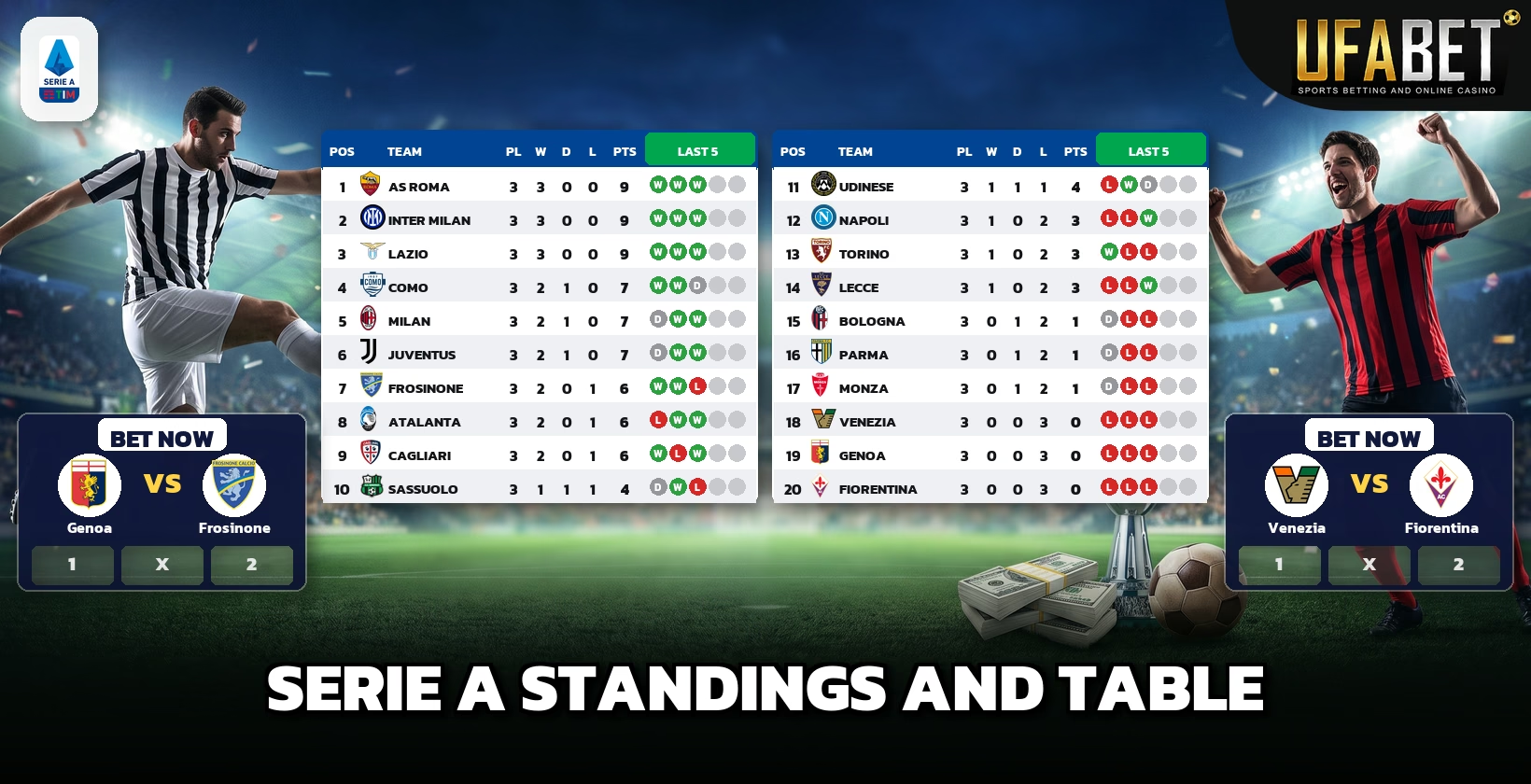
Serie A Standings and Table 2026/2027 place Inter Milan first with nine points from three matches played.Serie A Standings and Table 2026/2027 rank Como second, holding seven points from three matches through two wins and a single draw. Roma, AC Milan, Juventus, Atalanta and Lazio share six points apiece, each still on two matches played after an unbeaten start to the season. Udinese follows in eighth position with four points, ahead of a group including Frosinone, Napoli, Sassuolo, Cagliari, Torino and Lecce on three points.
Bologna, Parma, Monza, Venezia, Genoa and Fiorentina sit at the bottom of the table without a point recorded through the opening rounds. Position within the Serie A table reflects points earned, goal difference and matches completed across the early weeks of the season. Inter Milan's unbeaten record and wide goal difference currently separate the reigning champion from every other club in the division. The lower half of the table, populated by three promoted clubs and three established sides, points toward an early relegation battle. Results across the coming rounds will continue reshaping this order as every club moves toward an equal number of matches played.
Serie A standings and table are shown in the table below.
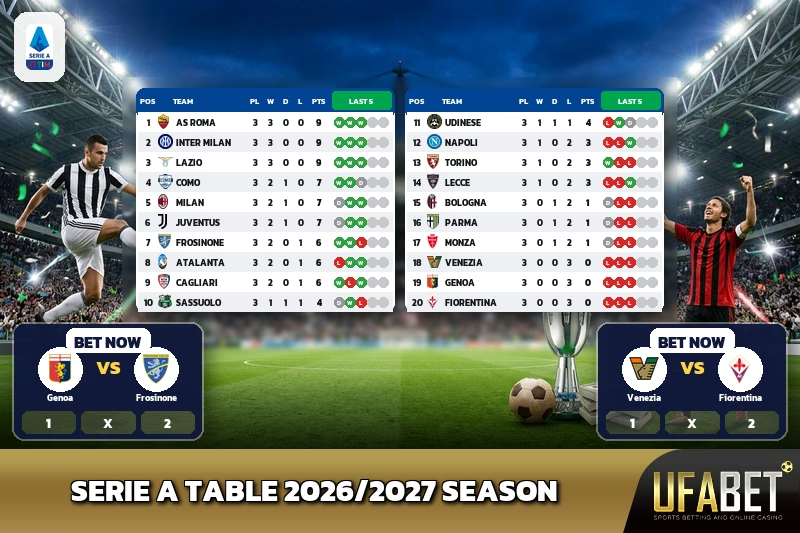
Serie A Table 2026/2027 Season
Looking at a league standings table gives fans, analysts and clubs a fast overview of season-long performance across every side in the division. Points, goal difference and matches played sit together, offering an immediate read on which clubs lead the title race and which face a fight against relegation. A single table condenses many individual results into a ranked order, saving time compared with checking each match report separately. Comparing wins, losses and goals across the division reveals patterns in attacking output and defensive solidity beyond points alone. Fans tracking European qualification races or relegation battles benefit directly from a table built around clear, comparable columns. The General tab combines every match a club plays across the season, blending home and away results into a single ranking. The Home tab isolates fixtures played at a club's own stadium, often producing a stronger points return given the advantage of familiar surroundings and local support. The Away tab isolates fixtures played at an opponent's ground, highlighting clubs that travel well against clubs that struggle outside home conditions. Switching between tabs reveals gaps hidden within the combined table, including a club performing strongly at home while struggling on the road. Roma's 4-0 home win over Fiorentina and Roma's 4-0 away win at Lecce each represent a result a home-only or away-only tab would isolate directly. Reviewing all three views together produces a fuller picture of a club's form than the General table offers alone. Serie A table for the 2026/2027 season is shown in the table below.
To read the Serie A table, follow the five steps listed below.
Check the position ranking.
Position ranking places clubs from first to last based on total points earned across the season. Higher points push clubs upward. Lower points push clubs downward.
Review the points column.
Points accumulate from wins worth three points plus draws worth one point. Losses add zero points to the total.
Compare goal difference.
Goal difference reflects the gap between goals scored and goals conceded. Clubs level on points get ranked by the higher goal difference.
Note matches played.
Matches played shows the number of games completed within the season. A club with fewer games completed sits lower on the table temporarily.
Examine home plus away form.
Home plus away splits reveal patterns behind performance across venues. A club dominant at home shows separate results on the road. The Serie A Games contribute the statistics that shape the rankings from week to week.
How Important Is the Serie A Table for Betting?
The Serie A table holds considerable importance for betting, offering a quick reference for form, goal output and defensive record before placing a wager. Bettors reviewing points, wins and goal difference gain insight into which clubs carry momentum into an upcoming fixture. Inter Milan's nine points from three matches signal a club converting chances consistently, a pattern often reflected in shorter odds for continued success. Goal difference figures, including Roma's plus eight from only two matches, help identify clubs likely to feature in markets built around goals scored or clean sheets. Clubs near the bottom, such as Genoa and Fiorentina, often carry longer odds against direct opponents given a shared lack of points through the opening rounds. Reading the table alongside recent form and head-to-head history typically produces a more informed view than points alone. Approaching football betting through table position, goal statistics, and match context together offers a stronger foundation than relying on reputation or history from previous seasons.
What Do the Columns in the Serie A Standings Mean?
The columns in the Serie A standings represent the core statistics used to rank every club across the season. Position, listed first, shows a club's current rank based on points and any applicable tie-breaking criteria. Pld, or matches played, records the number of fixtures a club has completed, allowing a fair comparison between clubs at different stages of a round. W, D and L show wins, draws and losses, together accounting for every match played and feeding directly into the points total. GF and GA record goals scored and goals conceded, combining into the GD column showing overall goal difference for the season. Pts, the final column, totals the points earned through three points for a win and one point for a draw. Inter Milan's row, showing three wins, eight goals scored, three conceded, and nine points, illustrates how each column builds toward the final ranking shown in the table.
How Are Serie A Teams Ranked in the Table?
Serie A teams are ranked in the table according to total points accumulated across the season. The league places clubs in order from highest to lowest points, with the top position occupied by Inter Milan at nine points after three matches. Goal difference and goals scored serve as separators when point totals match, though several clubs holding six points differ mainly through matches played rather than results alone. Matches played, wins, draws and losses feed into the ranking indirectly through the points they generate rather than through a separate scoring weight. Clubs positioned near the top qualify for European competition, including the Champions League and Europa League, while clubs near the bottom face relegation to Serie B. Roma, AC Milan, Juventus, Atalanta and Lazio sit level on six points, illustrating how closely grouped mid-table positions become early in a campaign. Rankings update after every round of fixtures, shifting positions as results change point totals and goal differences across the twenty-club division.
How Are Points Calculated in the Serie A Standings?
Points in the Serie A standings are calculated through a system awarding three points for a win, one point for a draw and zero points for a loss. Inter Milan recorded three wins from three matches, producing nine points at the top of the division. Roma, AC Milan, Juventus, Atalanta and Lazio each converted two wins from two matches into six points apiece, showing the direct link between results and points gained. Como reached seven points through two wins and one draw, illustrating how a single draw affects a points total compared with an additional win. Clubs at the foot of the table, including Genoa and Fiorentina, hold zero points after three matches without a win recorded. The system rewards attacking success without penalising goal totals directly, since a narrow win and a wide win both return three points. Point totals accumulate across thirty-eight rounds, forming the primary measure used to determine the final league position at the end of the season.
What Happens When Serie A Teams Have the Same Number of Points?
Serie A teams with the same number of points are separated through a set of tie-breaking criteria applied in order. Head-to-head points between the tied clubs form the first criterion, followed by head-to-head goal difference from matches played against each other. Overall goal difference across the season ranks third, followed by total goals scored when a tie remains unresolved. A coin toss or drawn lot applies as a final criterion in the rare case every prior measure ends level. Roma, AC Milan, Juventus, Atalanta and Lazio currently share six points, separated in the published table through goal difference and goals scored rather than points alone. Head-to-head results only apply once every fixture between the tied clubs has been completed, limiting the criterion early in a season. The full set of tiebreakers activates most often near the end of a campaign, deciding qualification places and relegation positions among closely matched clubs.
What Determines Serie A Standings and Team Positions?
Points earned from match results determine Serie A standings and team positions across the season. The league ranks twenty clubs from highest to lowest points, with wins, draws and losses feeding directly into each total. Inter Milan holds the top position with nine points from three matches, ahead of Como in second on seven points from an identical number of matches. Beyond points, the league applies goal difference, goals scored, head-to-head results and a drawn lot as sequential criteria whenever clubs finish level. Matches played also factor into early-season placement, since clubs completing fewer fixtures sit temporarily lower despite a comparable points rate. Roma, AC Milan, Juventus, Atalanta and Lazio occupy adjoining positions on six points, demonstrating how tightly the top of the table compresses after a small sample of fixtures. Position within the standings carries consequences beyond bragging rights, including qualification for European competition at the top and relegation exposure at the bottom.
How Do Wins, Draws, and Losses Affect the Serie A Table?
Wins, draws, and losses affect the Serie A table by directly setting the points total each club carries into its current position. Three points follow a win, one point follows a draw, and a loss yields nothing toward the standings. Inter Milan converted three wins from three attempts into nine points, placing the club clear of every side with a blemish on record. Genoa and Fiorentina have lost every match played, leaving both without a point near the foot of the division. A heavier reliance on draws over wins produces a slower points accumulation, shown by Como reaching seven points through two wins and one draw rather than three wins. The balance between these three outcomes across a season ultimately separates title contenders from clubs fighting against relegation. Every additional win shifts a club upward far more quickly than an equivalent number of draws, given the weighting built into the points system.
How Does Goal Difference Affect Serie A Rankings?
Goal difference affects Serie A rankings by separating clubs that finish level on points through the margin between goals scored and goals conceded. Roma holds a goal difference of plus eight after two matches, the highest figure in the division, built through consecutive clean sheets against Fiorentina and Lecce. Inter Milan follows closely at plus five, drawn from eight goals scored and three conceded across three matches played. Roma, AC Milan, Juventus, Atalanta and Lazio share six points, yet differ in goal difference, affecting the exact order among the five clubs. A wide goal difference signals dominant scoring, defensive solidity, or a combination of both across completed fixtures. Fiorentina shows a goal difference of minus eight, reflecting heavy defeats absorbed early in the campaign despite the club having faced three matches. The measure becomes decisive only after points and head-to-head results fail to separate tied clubs, functioning as a secondary ranking tool rather than a primary one.
How Are Goals Scored and Goals Conceded Used in the Serie A Standings?
Goals scored and goals conceded are used in the Serie A standings as the components forming each club's goal difference and, when needed, as an additional tiebreaking measure. The "GF" column records goals scored, while the "GA" column records goals conceded, together producing the "GD" figure listed beside each club. Roma leads goals scored with eight from only two matches, while Fiorentina has conceded nine against a return of one goal scored. Goals scored acts as a tiebreaker only after points, goal difference and head-to-head results leave clubs level, placing it fourth in the sequence of criteria. Inter Milan and Roma both show strong scoring records, though Inter Milan has conceded three goals compared with none for Roma across fewer matches. Tracking both figures separately allows a distinction between attacking output and defensive performance, two aspects a single goal difference number can obscure. The combination of scoring and conceding data therefore supports a fuller reading of a club's early-season form beyond points alone.
What Happens When Serie A Teams Remain Level on Points?
Serie A teams remaining level on points move first to a comparison of head-to-head points earned between the tied clubs during the season. Head-to-head goal difference follows as the second criterion, examining the scoreline from matches played directly between the clubs in question. Overall goal difference across the season ranks third, followed by total goals scored should the tie remain unresolved after the first three measures. Roma, AC Milan, Juventus, Atalanta and Lazio currently share six points, a tie the table currently resolves through overall goal difference rather than head-to-head results. The head-to-head criterion applies only once every scheduled meeting between the tied clubs has been completed across the season. This full sequence rarely activates early in a season, since points and goal difference typically separate clubs well before goals scored enters consideration. Regulations published by the league confirm this order, prioritising direct results between rivals ahead of wider season-long figures.
How Do Head-to-Head Results Affect Serie A Rankings?
Head-to-head results affect Serie A rankings by ranking tied clubs according to points earned against each other before overall goal difference applies. A club winning both meetings against a rival gains a head-to-head advantage even if the wider season goal difference favours the opponent. The criterion applies only after every scheduled meeting between the tied clubs has been completed, limiting its use during the opening rounds of a season. Head-to-head goal difference follows head-to-head points as a secondary layer, examining the scoreline from matches played directly between the clubs in question. Roma, AC Milan, Juventus, Atalanta and Lazio have yet to meet one another this season, meaning the criterion carries no current weight among the five. Once completed fixtures accumulate, head-to-head comparisons frequently decide close finishes for European qualification places and for survival battles near the bottom of the table. The rule rewards direct competitive success between rivals, treating it as a stronger indicator than results against the wider division.
Serie A Table 2026/2027 Statistics
Serie A Table 2026/2027 statistics provide a snapshot of team performance through points, wins, goals scored, goal difference and losses. Roma currently lead the standings with 9 points from 3 wins, while Inter sit level on points after the same unbeaten start. Roma hold the stronger goal difference at +9 after scoring 10 goals and conceding 1. The statistics highlight the strongest early performers across attacking and defensive categories. Roma lead the scoring charts, while Inter remain among the leading teams after a perfect opening run. The standings remain at an early stage of the 2026/2027 season, which began on 23 August 2026 and runs until 30 May 2027.
Which Team Has the Most Points in Serie A?
Roma and Inter have the most points in Serie A, with 9 points from 3 wins. Roma lead the table through a superior goal difference. Roma and Inter share the highest points total after perfect opening records. Roma hold the statistical advantage through 10 goals scored, 1 goal conceded, and a +9 goal difference. The figures indicate strong attacking output combined with disciplined defending during the opening matches.
Which Team Has the Most Wins?
Roma and Inter have the most wins in Serie A, with 3 victories each from 3 matches. Both teams have perfect records, with Roma leading on goal difference after scoring 10 goals and conceding 1. Roma and Inter lead the early Serie A standings through consistent results and strong attacking performances. Roma hold the stronger statistical record because the team has produced a +9 goal difference, compared with Inter’s +5.
Which Team Has Scored the Most Goals?
Roma have scored the most goals in Serie A, with 10 goals from 3 matches. Roma have scored 4 goals against Fiorentina, 4 against Lecce, and 2 against Atalanta. Inter rank second with 8 goals from 3 matches, followed by Como with 7 goals. Roma's attacking output has helped the club reach 9 points and a +9 goal difference, giving Roma the strongest overall goal record in the league. Roma's goal record reflects strong attacking efficiency during the opening fixtures. The club has combined the league's highest scoring total with just 1 goal conceded, creating the best goal difference among Serie A teams after 3 matches.
Which Team Has the Best Goal Difference?
Roma has the best goal difference in the Serie A standings, sitting at plus eight after two matches played this season. The figure comes from eight goals scored against none conceded, built through a 4-0 home win over Fiorentina and a 4-0 away win at Lecce. Inter Milan follows closely with a goal difference of plus five, drawn from eight goals scored and three conceded across three matches, and currently leads the points table with nine. Como sits third on goal difference at plus four, adding a draw to two wins for seven points from three matches played. Fiorentina carries the weakest goal difference in the division at minus eight, having scored once while conceding nine goals across three matches without a win. Malen leads the goalscoring charts with five goals for Roma, reinforcing the club's position at the top of the goal difference column. These figures combine points, goals and results into a single measure of early-season form across the twenty-club table. A wide goal difference typically reflects attacking output paired with defensive discipline, shown clearly through Roma's two clean sheets from two matches. Wins, goals scored, and goals conceded therefore work together to separate genuine early pace-setters from clubs still searching for their first points of the season.
Which Team Has the Fewest Losses?
Inter Milan has the fewest losses in the Serie A standings, with zero defeats recorded across three matches played this season. Como, Roma, AC Milan, Juventus, Atalanta and Lazio also remain unbeaten, though each has completed only two matches through the opening weeks. Inter Milan stands apart within this group by extending the run across an additional fixture, adding a third win without a blemish on record. The club also leads the points table with nine, built from three wins producing eight goals scored against three conceded. Roma holds the widest goal difference in the division at plus eight, drawn from consecutive clean sheets against Fiorentina and Lecce. Genoa and Fiorentina have each lost every match played, the highest defeat count recorded among clubs through the early rounds. These figures combine points, wins and goal difference into a single measure of early-season form across the twenty-club table. A club avoiding defeat signals consistency across attack and defence, though the small number of matches completed limits how much weight the record carries. Wins, losses and goal output therefore work together to separate genuine early pace-setters from clubs still searching for their first points of the season.
Which Team Has the Best Home Record?
Roma has the best home record in the Serie A standings, built around a 4-0 win over Fiorentina recorded on the opening matchday of the season. The result stands as the widest home victory margin recorded in the division so far this season. Inter Milan has also posted a strong home record, contributing to an unbeaten run maintained across three matches played overall. Both clubs have avoided a home defeat through the early rounds, keeping pace with each other near the top of the standings. The club also leads the goal difference column at plus eight, aided directly by two clean sheets from two home and away fixtures. Clubs including Atalanta and Lazio have posted narrower home results, protecting slim leads rather than recording wide winning margins. A strong home record at this stage often reflects an early rhythm rather than a guaranteed pattern across a full season.
Which Team Has the Best Away Record?
Roma holds the best away record in the Serie A standings, highlighted by a 4-0 victory at Lecce recorded during the opening weeks of the season. The result stands as the widest away winning margin recorded across the division so far this season. Inter Milan has also posted a positive away record, contributing to an unbeaten run spanning both home and away fixtures through three matches played. Both clubs remain among the sides yet to drop points on the road through the early rounds of the season. Inter Milan currently leads the points table with nine, built from three wins producing eight goals scored against three conceded. Roma's combined home and away form has produced a goal difference of plus eight, the strongest recorded in the division so far. These figures combine points, goals and away results into a single measure of early-season form across the twenty-club table. A wide away winning margin this early in the season signals a settled attacking approach independent of venue. Wins, goal difference and away form therefore work together to separate genuine early pace-setters from clubs still adjusting to the demands of the season.
Which Team Is at the Bottom of the Serie A Table?
Fiorentina sits at the bottom of the Serie A table, holding zero points from three matches played this season. The club has scored one goal while conceding nine, producing a goal difference of minus eight, the weakest recorded in the division. Genoa occupies the position directly above Fiorentina, also without a point but carrying a stronger goal difference at minus six. Both clubs share three losses from three matches, distinguished only by goals scored and conceded across the opening rounds. Inter Milan, by contrast, leads the points table with nine, built from three wins and a goal difference of plus five. Fiorentina's position at the foot of the table places the club under early relegation scrutiny well before the midpoint of the season. A points return of zero this early often prompts tactical or squad changes aimed at reversing form before the gap to safety widens further. Serie A Standings and European Qualification 2026/2027
Serie A Standings and European Qualification 2026/2027
Serie A Title Race and Champions League Places
Serie A Relegation and Promotion 2026/2027
Factors That Influence the Serie A Table
Serie A Standings 2026/2027 vs Previous Seasons
Serie A Standings and Match Results
Which Serie A Positions Qualify for the UEFA Champions League?
The top four positions in the Serie A table qualify clubs for the UEFA Champions League league phase this season. Inter Milan currently occupies first position with nine points, ahead of Como in second on seven points from three matches played. Roma, AC Milan, Juventus, Atalanta and Lazio sit level on six points, each having completed only two matches so far this season. A fifth Champions League place becomes available for Italy when the country ranks among the two associations holding the highest UEFA coefficient, shifting qualification down from the standard four places. Clubs finishing within the top four typically enter the league phase directly, avoiding the additional hurdle of a preliminary qualifying round. Rankings remain unsettled this early in the campaign, since several clubs occupying the qualification places have yet to reach an equal number of matches played. Bettors following the race often turn to UEFA Champions League betting tips and strategies for guidance on how the qualification picture may develop across the season.
Which Serie A Positions Qualify for the UEFA Europa League?
Fifth position in the Serie A table qualifies a club directly for the UEFA Europa League league phase this season. Juventus currently holds fifth position with six points from two matches, level with several clubs above and below through the opening rounds. A separate Europa League place goes to the winner of the Coppa Italia, freeing the fifth-placed league spot for the next-highest finisher when the cup winner already qualifies through position. Should the Coppa Italia winner finish in the top five, the sixth-placed club in the league moves into the Europa League place instead. Atalanta currently sits sixth on six points, positioned to benefit directly should that scenario unfold at the end of the season. The interaction between cup success and league position therefore shapes the exact club occupying this qualification route. Coverage of the competition, including UEFA Europa League betting tips and strategies, often tracks this fifth and sixth position battle closely through the closing months of a season.
Which Serie A Position Qualifies for the UEFA Conference League?
Sixth position in the Serie A table qualifies a club for the UEFA Conference League play-off round this season. Atalanta currently occupies sixth position with six points from two matches, level with several clubs above through the early rounds. The Conference League slot sits directly beneath the Europa League place, forming the final rung of European qualification available through league position alone. A club finishing sixth enters the play-off round rather than the group stage, adding an extra hurdle before the competition proper begins. Domestic cup results can shift the exact place allocated to sixth position, depending on how the Coppa Italia winner's final league position compares with the standard qualification places. The position therefore carries a conditional route into Europe rather than a fully guaranteed one. Clubs occupying sixth position through the closing rounds of the season typically face a tighter contest than those placed above them in the standings.
How Does the Serie A Table Determine European Qualification?
The Serie A table determines European qualification through final league position once all thirty-eight rounds of the season have been completed. Positions one to four earn entry into the UEFA Champions League league phase, extending to five places when Italy ranks among the top two associations by UEFA coefficient. Position five earns entry into the UEFA Europa League league phase, rewarding the strongest form immediately below the Champions League places. Position six earns entry into the UEFA Conference League play-off round, forming the lowest tier of European qualification available through the league alone. Inter Milan and Como currently sit inside the Champions League places, while Juventus and Atalanta occupy the Europa League and Conference League positions respectively. Final standings rather than mid-season position decide the outcome, since points gaps frequently shift across a full campaign. League position therefore functions as the primary mechanism determining which clubs represent Italy in European competition each season.
Can the Coppa Italia Affect European Qualification?
Yes, the Coppa Italia can affect European qualification by awarding its winner a place in the UEFA Europa League league phase. A club winning the Coppa Italia while also finishing high enough in the league table to qualify for Europe through position frees up its cup-earned place for another club. The freed place typically passes to the next-highest league finisher outside the positions already carrying European qualification. Should the Coppa Italia winner finish in the top five of the league, the sixth-placed club moves into the Europa League place rather than the Conference League play-off round. The mechanism therefore shifts the sixth-placed club's route into Europe, depending entirely on where the cup winner finishes in the league. Bologna, Fiorentina and Napoli have won recent editions of the Coppa Italia, illustrating how a mid-table finish alongside cup success can still produce a European place. The interaction between cup results and league position adds a conditional layer to qualification, separate from but connected to final league standing. Serie A Title Race and Champions League Places


 SS Lazio
 Inter Milan
 AS Roma
 Como 1907
 AC Milan
 Frosinone Calcio
 Juventus
 Bologna FC 1909
 Cagliari Calcio
 SSC Napoli
 Torino
 Genoa CFC
 Atalanta BC
 US Lecce
 ACF Fiorentina
 Parma Calcio 1913
 US Sassuolo Calcio
 AC Monza
 Venezia
 Udinese Calcio
 There are no matches at the moment.


