


Original of J.League Standings and Table is in https://ufabet.auto/en/football/j-one-league/table-standing
J.League Standings and Table
The J.League standings and table show where each of the 20 clubs currently sits in the 2026/2027 season, based on total points earned across matches played, wins, draws, and losses. The j1 league standings provide a clear snapshot of the current league hierarchy, while the japan j league table shows the positions of clubs from the top to the bottom of the competition.
The current J.League standings for the 2026/2027 season are shown in the table below.
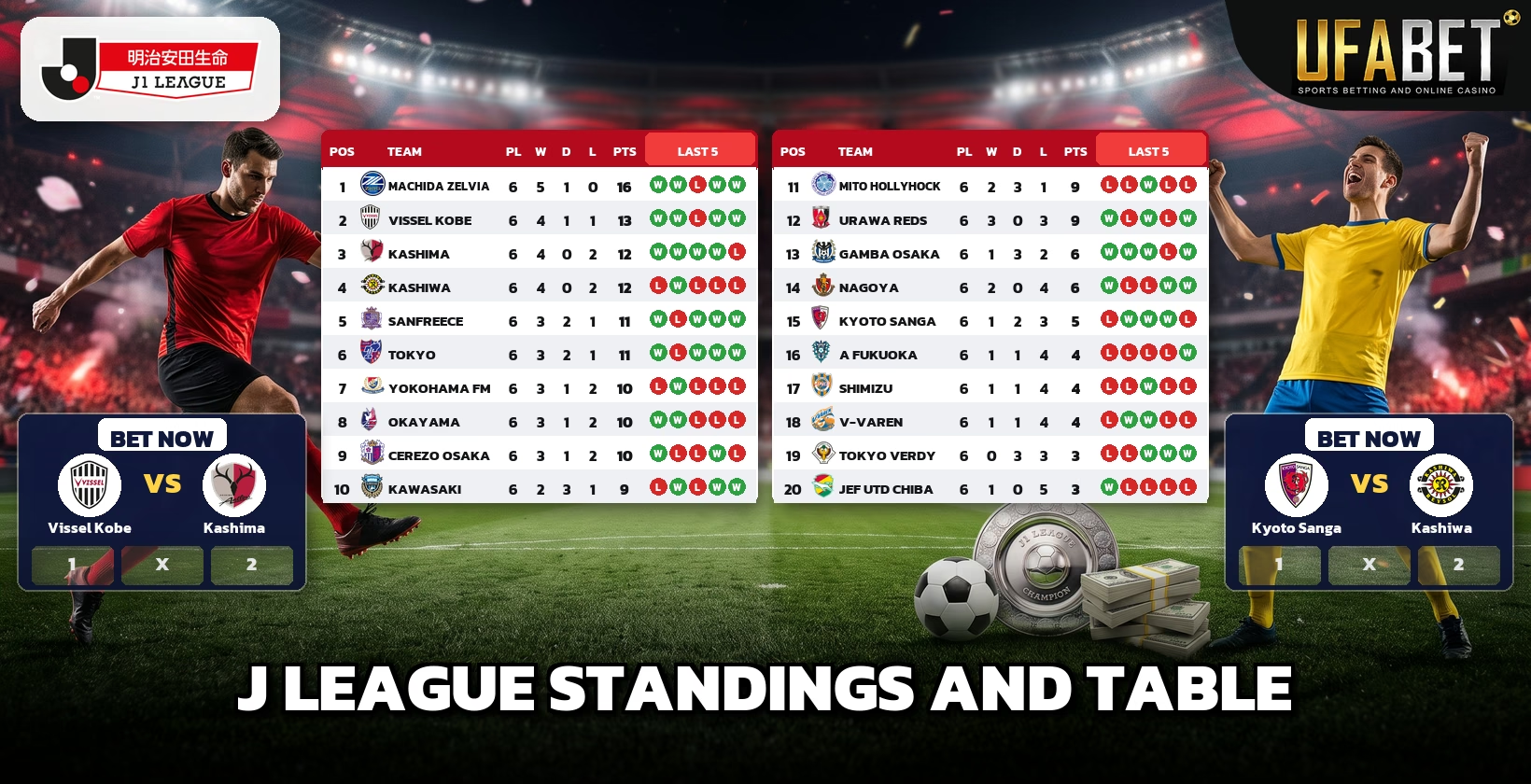
J.League Table 2026/2027 Season

Premier League Live Matches and Upcoming Fixtures
 There are no matches at the moment.
How to Read the J.League Table?
The following steps explain what each section shows.
Check the Position.
The position column ranks clubs according to points earned. FC Machida Zelvia currently holds first place on 16 points after 6 matches.
Review Matches Played.
The matches played column shows completed fixtures. Comparing clubs after an equal number of matches gives a clearer performance reference.
Compare Wins, Draws, and Losses.
Wins provide 3 points, draws provide 1 point, and losses provide 0 points. FC Machida Zelvia has 5 wins, 1 draw, and 0 losses after 6 matches.
Review Goals Scored and Conceded.
Goals scored indicate attacking output, while goals conceded indicate defensive performance. FC Machida Zelvia has scored 18 goals and conceded 5, producing a +13 goal difference.
Check Goal Difference.
Goal difference comes from subtracting goals conceded from goals scored. FC Machida Zelvia's +13 difference currently leads the table.
Compare Total Points.
Compare Total Points. Total points determine the primary ranking. Recent results alongside points provide useful context through Japan League Games.
How Important Is the J.League Table for Betting?
The J.League table is highly useful for football betting since league position shows points, wins, losses, goals scored, goals conceded, goal difference, recent form. Current standings provide a quick view of team strength before a match. FC Machida Zelvia leads the 2026/2027 table after matchweek 6, collecting 16 points from 6 matches. Vissel Kobe follows on 13 points. Recent results provide further context since form reveals momentum across recent fixtures. Home records, away records, scoring rates, defensive records help assess match possibilities. Standings alone do not determine a result, yet the table provides a strong starting point when exploring <<<Football Betting>>> options.
What Do the Columns in the J.League Standings Mean?
The J.League standings columns show position, matches played, wins, draws, losses, goals scored, goals conceded, goal difference, points, recent form. Position shows a club's place in the table. Matches played records completed fixtures. Wins, draws, losses show match outcomes. Goals scored records attacking output. Goals conceded records goals allowed. Goal difference comes from goals scored minus goals conceded. Points come from match results. Recent form gives a short record of previous results, usually shown through letters such as W, D, L. After Matchweek 6, FC Machida Zelvia sits first on 16 points, followed by Vissel Kobe on 13.
How Are J.League Teams Ranked in the Table?
J.League teams are ranked first by total points, followed by goal difference, goals scored, head to head points, head to head goal difference, head to head goals scored. A win gives 3 points, a draw gives 1 point, a defeat gives 0 points. Goal difference becomes the next ranking measure when clubs finish level on points. Goals scored follows goal difference. Head to head criteria then settle further ties. A final drawing of lots exists if every listed criterion remains equal. The ranking system therefore gives priority to points before scoring statistics or direct meeting records.
How Are Points Calculated in the J.League Standings?
J.League points come from match results. A victory gives 3 points, a draw gives 1 point, a defeat gives 0 points. Six victories therefore produce 18 points. Six draws produce 6 points. Six defeats produce 0 points. FC Machida Zelvia has 16 points after 6 matches, created by 5 wins, 1 draw, 0 defeats. Vissel Kobe has 13 points from 4 wins, 1 draw, 1 defeat. Point totals determine the primary table order before goal difference or later tie breakers are applied.
What Do Wins, Draws, and Losses Mean in the J.League Table?
Wins add 3 points, draws add 1 point, losses add 0 points to the J.League table. Match results therefore have a direct effect on league position. FC Machida Zelvia has 5 wins from 6 matches, giving the club 16 points after one draw. A club collecting consecutive wins gains ground quickly. A sequence of defeats produces no points, leaving rivals opportunities to move ahead. Draws provide one point, helping limit the damage from a match without a victory.
What Happens When J.League Teams Have the Same Number of Points?
Teams level on points are separated first by goal difference in the J.League standings. Goal difference comes from goals scored minus goals conceded. Goals scored becomes the next criterion when goal difference remains equal. Head to head points then follow, followed by head to head goal difference, head to head goals scored. A drawing of lots is the final listed method if every prior criterion remains equal. The system prevents tied point totals from automatically producing identical league positions.
What Determines J.League Standings and Team Positions?
J.League standings are determined by points first, followed by goal difference, goals scored, head to head points, head to head goal difference, head to head goals scored. Match results create the initial points total. Goal difference then separates clubs carrying equal points. Goals scored provides another ranking measure. Direct meetings become relevant after the earlier criteria. FC Machida Zelvia currently leads the 2026/2027 table through 16 points, a +13 goal difference, 18 goals scored. The ranking therefore reflects both match results plus scoring performance.
How Do Wins, Draws, and Losses Affect the J.League Table?
Wins raise a club's point total by 3, draws add 1, losses add 0. Five wins therefore create 15 points before any draws are added. FC Machida Zelvia has 5 wins plus 1 draw, producing 16 points after matchweek 6. Vissel Kobe has 4 wins, 1 draw, 1 loss, producing 13 points. A single result therefore changes the point gap between nearby clubs. Repeated victories create faster movement towards the top, whereas repeated defeats increase pressure near the relegation places.
How Does Goal Difference Affect J.League Rankings?
Goal difference separates J.League teams level on points. The calculation subtracts goals conceded from goals scored. FC Machida Zelvia currently owns the strongest goal difference at +13, created by 18 goals scored plus 5 conceded. Sanfrecce Hiroshima follows at +8. A positive goal difference strengthens a club's position when point totals match another team. A negative figure indicates that a club has conceded more goals than it has scored. Goal difference therefore becomes a direct ranking factor after total points.
How Are Goals Scored and Goals Conceded Used in the J.League Standings?
Goals scored plus goals conceded create goal difference, which ranks clubs after points. Goals scored then acts as a separate ranking criterion when goal difference remains equal. FC Machida Zelvia has scored 18 goals after 6 matches, giving the league leader the highest scoring total. The club has conceded 5 goals, producing a +13 goal difference. Strong attacking output raises goals scored, whereas defensive weaknesses raise goals conceded. Both figures therefore contribute directly to the table through goal difference plus the goals scored tie breaker.
What Happens When J.League Teams Remain Level on Points and Goal Difference?
Teams level on points plus goal difference are separated by goals scored. Head to head points follow if goals scored remains equal. Head to head goal difference then applies, followed by head to head goals scored. A drawing of lots remains the final listed criterion if every previous measure produces identical records. The sequence gives scoring output priority before direct meeting records become relevant. League position therefore remains determined even when two clubs share identical points plus goal difference.
How Do Head-to-Head Results Affect J.League Team Rankings?
Head to head results affect J.League rankings after points, goal difference, plus goals scored. Head to head points come first among the direct meeting criteria. Head to head goal difference follows, then head to head goals scored. Direct results therefore become relevant only after earlier table measures remain equal. A club holding the stronger direct record gains an advantage under the relevant tie breaker. The system gives previous meetings a defined role rather than using league position or alphabetical order to settle a tie.
J.League Standings 2026/2027 Statistics
The 2026/2027 J.League standings currently have FC Machida Zelvia at the top after Matchweek 6. Machida has 16 points, 5 wins, 1 draw, 0 losses, 18 goals scored, 5 conceded, plus a +13 goal difference. Vissel Kobe sits second on 13 points. Kashima Antlers plus Kashiwa Reysol follow on 12 points. Sanfrecce Hiroshima plus FC Tokyo each have 11 points. At the bottom, JEF United Chiba has 3 points from 6 matches.
Which Team Has the Most Points in J.League?
FC Machida Zelvia has the most points in the J.League after matchweek 6, holding 16 points. The club has recorded 5 wins, 1 draw, 0 losses across 6 matches. Vissel Kobe sits second on 13 points, leaving Machida 3 points clear at the top. Machida has scored 18 goals plus conceded 5, producing a +13 goal difference. The unbeaten start gives the club the strongest points total at the current stage of the 2026/2027 competition.
Which Team Has the Most Wins?
FC Machida Zelvia has the most wins in the J.League after matchweek 6, recording 5 victories from 6 matches. The only result outside a win was a 1 to 1 draw away against Mito Hollyhock. Machida then defeated Nagoya Grampus 3 to 1 on 6 September, extending the unbeaten start. Vissel Kobe follows on 4 wins. Kashima Antlers plus Kashiwa Reysol also have 4 wins. Machida therefore leads the league for victories alongside the strongest current points total.
Which Team Has Scored the Most Goals?
FC Machida Zelvia has scored the most goals in the J.League after matchweek 6, reaching 18 goals. The total comes from a 5 to 1 victory over FC Tokyo, a 4 to 0 victory over JEF United Chiba, a 3 to 1 victory over Urawa Reds, a 1 to 1 draw at Mito, a 2 to 1 victory over Kawasaki Frontale, plus a 3 to 1 victory at Nagoya. Machida therefore leads the scoring chart alongside the points table.
Which Team Has the Best Goal Difference?
FC Machida Zelvia has the best goal difference in the J.League, standing at +13 after Matchweek 6. Machida has scored 18 goals plus conceded 5. Sanfrecce Hiroshima has the second strongest figure at +8. Vissel Kobe follows at +5. A +13 figure gives Machida a strong advantage under the first scoring based tie breaker. The figure also reflects the club's strong attacking output plus relatively low goals conceded across the opening 6 fixtures.
Which Team Has the Fewest Losses?
FC Machida Zelvia has the fewest losses in the J.League after matchweek 6, recording 0 defeats. Machida has won 5 matches plus drawn 1 match across the opening 6 fixtures. Mito Hollyhock has likewise avoided defeat across 5 matches, though Mito has 2 wins plus 3 draws. Machida therefore combines the unbeaten record with the highest points total. The 3 to 1 victory over Nagoya Grampus on 6 September preserved Machida's unbeaten league start.
Which Team Has the Best Home Record?
FC Machida Zelvia has the best home record after Matchweek 6, winning all 4 home league matches. Home victories came against FC Tokyo, JEF United Chiba, Urawa Reds, plus Kawasaki Frontale. Machida has collected 12 points from 12 available at home. The home record includes 14 goals scored plus 3 conceded. The perfect home start gives Machida a strong foundation at the top of the 2026/2027 standings.
Which Team Has the Best Away Record?
FC Machida Zelvia has one of the strongest away records after Matchweek 6, collecting 4 points from 2 away matches. Machida drew 1 to 1 at Mito Hollyhock before winning 3 to 1 at Nagoya Grampus. The record contains 1 win, 1 draw, 0 losses. Mito Hollyhock has collected 1 win plus 2 draws across 3 away fixtures. A full away ranking requires comparison across every club's away fixtures, so Machida's verified record is best described as one of the strongest current away starts.
Which Team Is at the Bottom of the J.League Table?
JEF United Chiba is at the bottom of the J.League table after matchweek 6, sitting 20th on 3 points. Chiba has 1 win plus 5 losses from 6 matches. The club has scored 5 goals plus conceded 15, producing a -10 goal difference. Tokyo Verdy sits 19th on 3 points, also carrying a winless record but holding a stronger goal difference at -6. JEF United Chiba therefore occupies the final position through the current ranking criteria.
Which J.League Positions Qualify for the UEFA Champions League?
No J.League position qualifies for the UEFA Champions League. Japanese clubs compete through the AFC system rather than UEFA, so J.League standings lead to AFC club competitions instead of European qualification. For the 2026/2027 cycle, Kashima Antlers, Vissel Kobe, and Kashiwa Reysol hold direct AFC Champions League Elite places, while Kyoto Sanga F.C. and Gamba Osaka hold indirect places. FC Machida Zelvia holds the AFC Champions League Two place after winning the Emperor’s Cup. Clubs seeking information on <<<UEFA Champions League>>> therefore need to distinguish European qualification from Japan’s AFC qualification routes.
Which J.League Positions Qualify for the UEFA Europa League?
No J.League position qualifies for the UEFA Europa League. Japanese clubs compete within the AFC system, so finishing first, second, third, or another J1 position does not provide a UEFA Europa League place. Japan's continental routes lead to the AFC Champions League Elite and AFC Champions League Two, based on J.League results, domestic cup results, and the applicable AFC allocation rules. UEFA's 2026/27 Europa League access list covers clubs from UEFA member associations, while Japan's 2026/27 continental allocation falls under AFC competitions. Clubs therefore remain within the Asian qualification pathway rather than entering the <<<UEFA Europa League>>> through the J.League table.
Which J.League Position Qualifies for the UEFA Conference League?
No J.League position qualifies for the UEFA Conference League. UEFA competitions are reserved for clubs from UEFA member associations. Japan belongs to the Asian Football Confederation, so Japanese clubs pursue AFC competitions instead. J.League success therefore connects to AFC Champions League Elite or AFC Champions League Two routes rather than UEFA Conference League qualification. League position alone does not create access to European club competitions.
How Does the J.League Table Determine European Qualification?
The J.League table determines continental qualification through Japan's AFC allocation rather than UEFA qualification. League position forms part of the domestic sporting pathway, yet cup results plus competition regulations also affect the final allocation. Japan has direct ACL Elite places, indirect ACL Elite places, plus an ACL Two place. For 2026/2027, Kashima Antlers, Vissel Kobe, Kashiwa Reysol hold direct ACL Elite positions. Kyoto Sanga F.C. plus Gamba Osaka hold indirect ACL Elite places.
Can the Copa del Rey Affect European Qualification From J.League?
No, The Copa del Rey does not affect European qualification from the J.League. The Copa del Rey is part of Spain's domestic football system, so its results affect Spanish clubs rather than Japanese clubs. J.League clubs follow the AFC qualification system, meaning domestic league and cup results connect to AFC Champions League Elite or AFC Champions League Two places rather than UEFA competitions. UEFA's 2026/27 access list confirms that European qualification is allocated through UEFA member associations, including Spain.